
Scaling High-Throughput Distributed Systems: A Visual Deep Dive
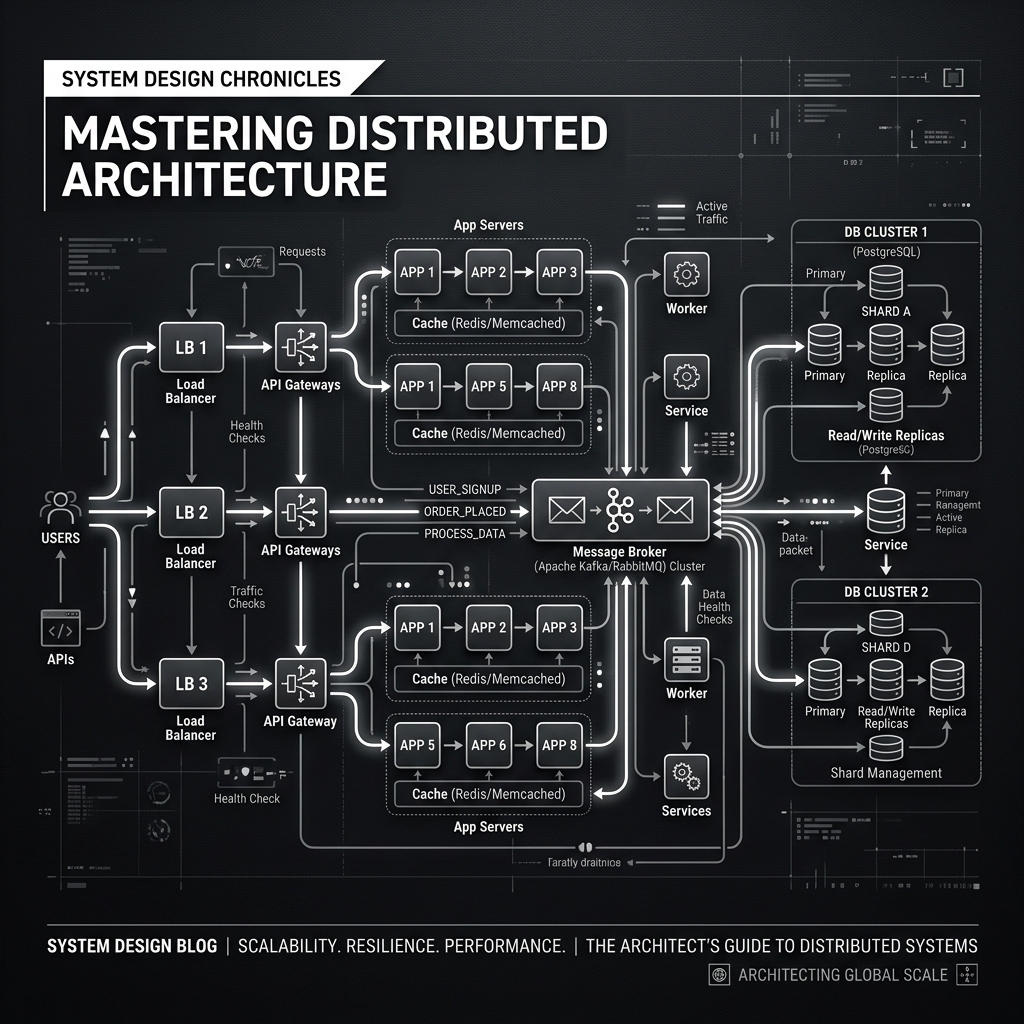
When a software system transitions from handling a few hundred requests a second to millions, the primary bottleneck shifts from writing efficient code to coordinate resource communications. Scaling is, at its core, the study of managing bottlenecks, reducing latency, and ensuring data consensus across network boundaries.
In this visual deep dive, we will break down the crucial layers of high-scale distributed systems: load balancers, cache consistency patterns, consistent hashing rings, messaging guarantees, and consensus algorithms.
1. Load Balancing: Layer 4 vs Layer 7 Routing
Load balancers act as traffic cops, distributing requests across web servers. However, they route traffic at different abstraction levels of the OSI model:
Experiment below with how different load balancer algorithms distribute traffic to backends:
2. Caching Strategies: Cache-Aside vs Write-Behind
Caching is the single most effective way to optimize database load, but it introduces the hardest problem in computer science: cache invalidation.
A. Cache-Aside (Lazy Loading)
The application queries the cache first. If there is a cache miss, it reads the data from the database, writes it to the cache, and returns it to the client.
Tradeoff: Cache misses suffer double-query latency. Data can become stale if updates go directly to the DB without purging cache.
B. Write-Behind (Write-Back)
The application writes data directly to the cache. An asynchronous worker or queue subsequently syncs this cache change back to the database.
Tradeoff: Extremely low write latency, but if the cache crashes before the data syncs to the DB, data is lost.
Advanced Bug: The Cache Stampede (Thundering Herd)
When a hot cache key expires, thousands of concurrent requests might hit the cache simultaneously, see a miss, and query the database at the exact same moment. This can easily trigger database lockouts.
func FetchHotKey(key string) (Data, error) {
val, ok := Cache.Get(key)
if ok { return val, nil }
// Lock so only 1 thread fetches from DB
Mutex.Lock(key)
defer Mutex.Unlock(key)
// Double-check cache inside lock
val, ok = Cache.Get(key)
if ok { return val, nil }
dbVal := Database.Query(key)
Cache.Set(key, dbVal, expire)
return dbVal, nil
}
3. Sharding & Consistent Hashing Rings
When a database grows too large for a single machine, we shard (partition) it. However, simple sharding algorithms like Hash(key) % N (where N is the number of database servers) have a critical flaw: if N changes (adding/removing a node), almost all keys map to new servers. This triggers a massive database query cascade as cache hit rates drop to zero.
Consistent Hashing solves this by mapping both servers and keys onto a circular ring (hash ring):
Keys are hashed and mapped to a position on the ring. The system traverses clockwise to find the first server node. When a node is added or removed, only a fraction of keys (roughly K/N) need to be remapped to other nodes, leaving the rest of the database cluster unaffected.
4. Message Queues & Event Delivery Guarantees
Event-driven microservices rely on message brokers like Kafka or RabbitMQ. When designing event pipelines, you must choose a delivery guarantee:
Messages are dispatched without confirmation. If a network blip occurs or a worker crashes, the event is permanently lost.
The producer keeps retrying until it receives an acknowledgment. This guarantees no message loss, but can deliver duplicates.
Architectural Solution: Workers must be idempotent (handling the same event twice results in the same state) by using unique idempotency keys inside a relational database table (e.g., transaction_id under a UNIQUE constraint).
Guarantees that a message is processed exactly once by using transactional coordination (like Kafka's transaction API) between producer, broker, and consumer database. This is slow and complex, but crucial for financial structures.
5. Distributed Consensus & Replication Log
To avoid a single point of failure, data must be replicated across servers. But how do nodes agree on the state of data? This is solved by distributed consensus protocols like **Raft** or **Paxos**.
In Raft, one node is elected as the **Leader**, and all client writes go directly to it. The Leader appends the command to its log and broadcasts it to **Follower** nodes. Once a majority (quorum) of followers acknowledge the write, the Leader commits it and notifies the clients.
If the Leader crashes, the followers detect the missing heartbeat and elect a new leader automatically.
Summary & Key Takeaways
- Choose Layer 4 Load Balancing for high packet speeds; choose Layer 7 Load Balancing for smart Application-routing.
- Mitigate Cache Stampede by implementing a single-flight mutex locking strategy around database calls.
- Leverage Consistent Hashing Rings when sharding relational or key-value database pools to ensure minimal keys remap during scaling events.
- Always design for At-Least-Once event streams by implementing idempotent workers on consumer clusters.